
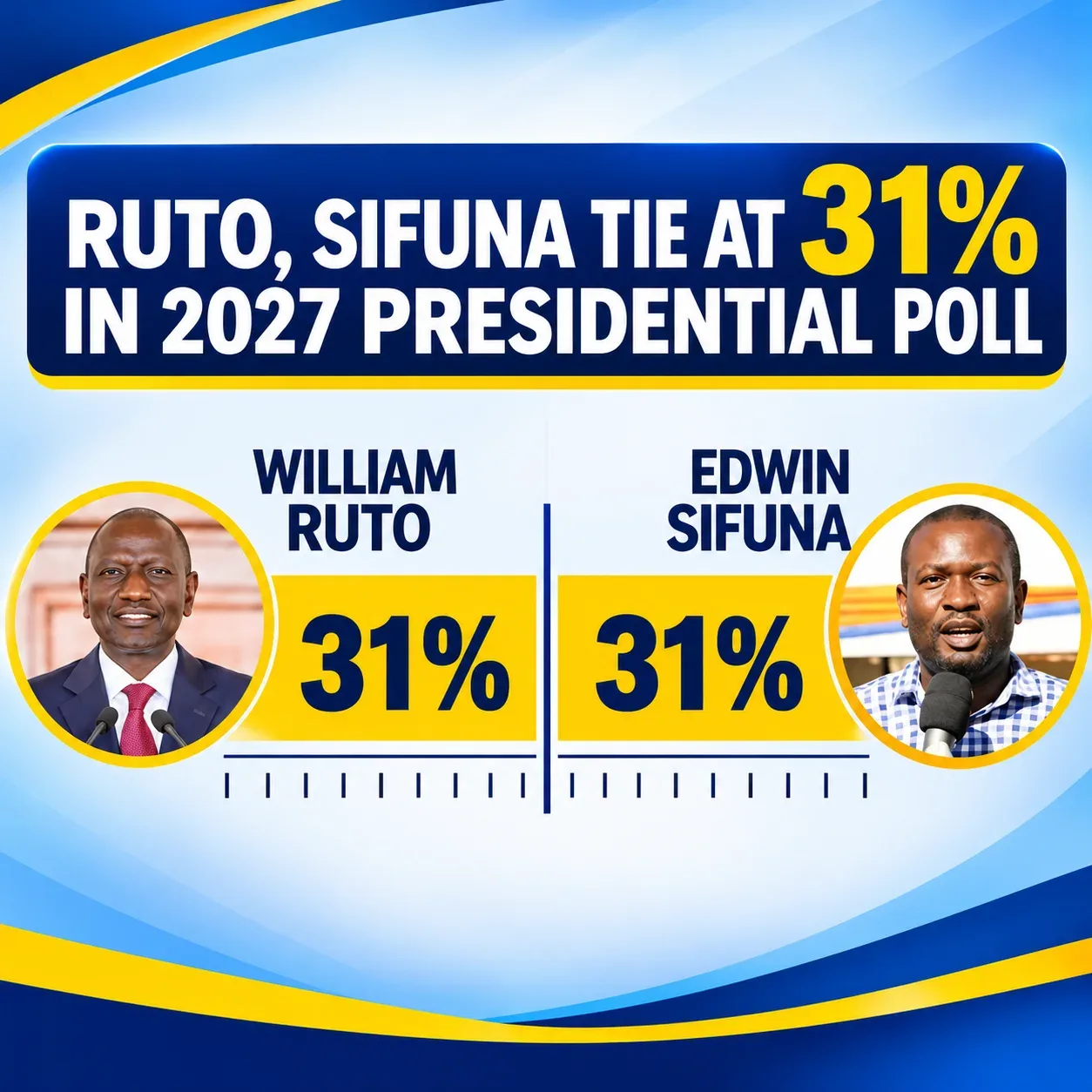
President William Ruto and Nairobi Senator Edwin Sifuna have emerged as joint frontrunners in the race for the 2027 presidency, each commanding 31 per cent popularity, according to the latest TIFA Research opinion poll.
The findings, released on Thursday, November 12, 2026, point to a significant shift in Kenya's political landscape, with Sifuna recording a remarkable surge in popularity while Ruto also gains ground.
Sifuna's rating has risen from 15 per cent in the previous survey to 31 per cent, representing a 16-percentage-point increase. Ruto's support has climbed from 24 per cent to 31 per cent, a seven-percentage-point gain.
The findings place the two politicians ahead of other potential presidential contenders, with former Vice President Kalonzo Musyoka trailing at nine per cent.
Former Interior Cabinet Secretary Fred Matiang'i follows with five per cent, while former Deputy President Rigathi Gachagua commands four per cent. Kiharu MP Ndindi Nyoro registers one per cent.
The poll also indicates that 15 per cent of respondents remain undecided about their preferred presidential candidate, while four per cent declined to disclose their choice.
Linda Mwananchi overtakes ODM
The survey also reveals significant changes in political party popularity, with the ruling United Democratic Alliance (UDA) retaining the top position at 25 per cent.
The Linda Mwananchi movement, associated with Sifuna, has emerged second with 17 per cent, overtaking the Orange Democratic Movement (ODM), whose popularity has dropped to 10 per cent.
The findings represent a significant setback for ODM, which has been grappling with internal divisions over its political direction and relationship with President Ruto's administration.
The emergence of Linda Mwananchi as the second-most popular political formation could further complicate ODM's internal politics, particularly as the movement's leaders continue to challenge the party's cooperation with UDA.
Other parties include Rigathi Gachagua's Democracy for Citizens Party (DCP) at nine per cent, Wiper at five per cent and Jubilee at four per cent.
Notably, 28 per cent of respondents remain undecided about their preferred political party, suggesting that a significant section of the electorate has yet to settle on a political home ahead of the 2027 General Election.
The latest findings provide a new indication of the shifting political alliances and growing competition likely to shape the country's next presidential contest.