
For younger Kenyans accustomed to political memes, viral videos and online satire, Maddo offers a reminder that the art of making power uncomfortable did not begin with social media.
For more than three decades, Paul Kelemba, better known as Maddo, has used cartoons to puncture political egos, expose public absurdities and document the country’s changing fortunes. His work is more than entertainment: It is an illustrated record of Kenya’s political history, told through the eyes of an artist who has never been afraid to laugh at those in charge.
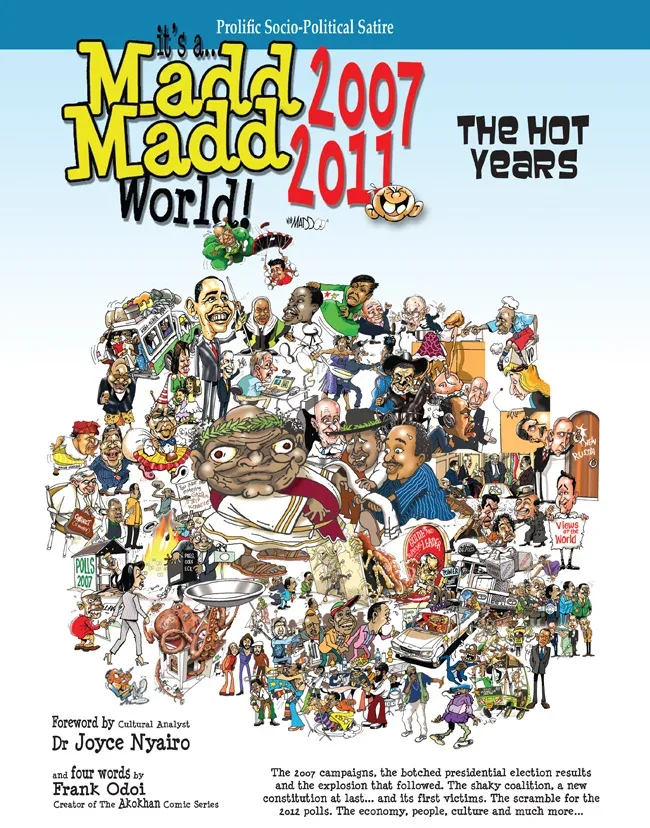
On Saturday, October 31, 2026, Maddo launched his second anthology at the Kenya National Library Services headquarters in Nairobi. Published by Zand Press, the book brings together cartoons published in The Standard between 2012 and 2016, years marked by the implementation of the 2010 Constitution, the 2013 General Election and the beginnings of devolved government.
“The book is a compilation of my work published by The Standard between 2012 and 2016,” Kelemba said.
The anthology examines how politicians navigated the new constitutional order and how devolution, despite its promise of bringing government closer to the people, has often been undermined by corruption. Revenue allocated to counties has not always translated into better services, with some county administrations becoming centres of public resource plunder.
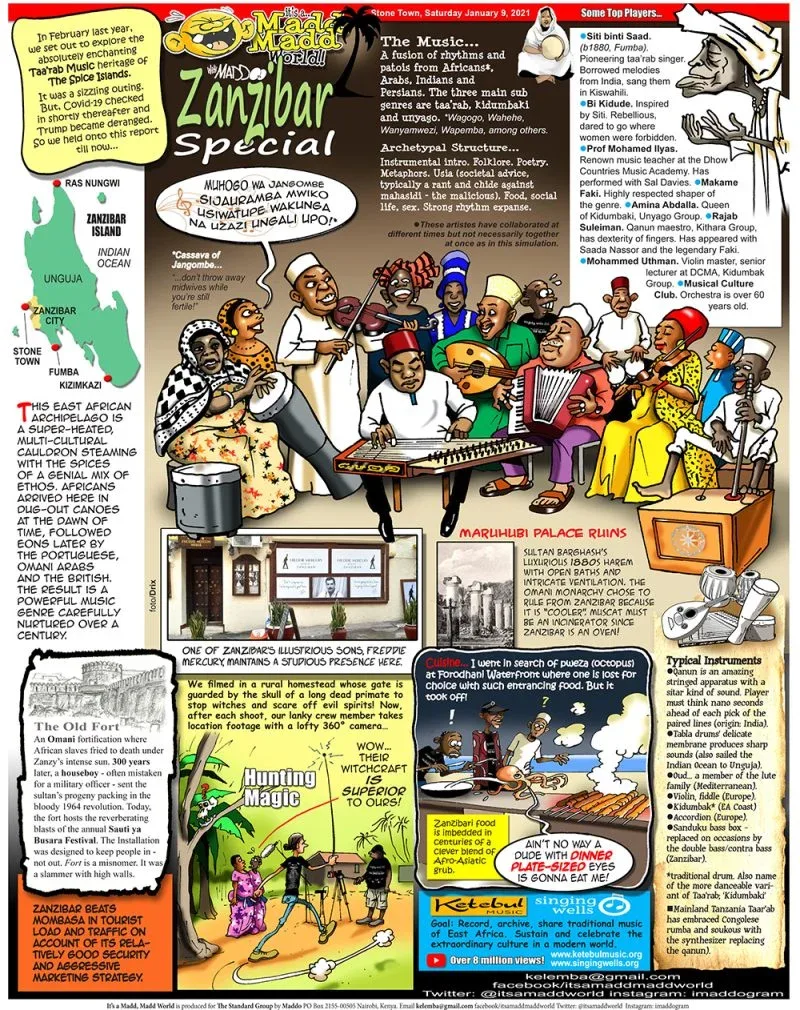
Maddo’s weekly full-page feature, MADD, appears in the Saturday Standard. Since joining the newspaper in 2001, he has produced approximately 50 episodes annually, documenting the country’s political and social journey.
His first anthology, The Hot Years 2007 to 2011, emerged from the turbulent period surrounding the 2007-2008 post-election violence. The new collection continues that historical record.
Laughing at power is serious business
The launch brought together journalists, artists and prominent public figures, including anti-corruption campaigner John Githongo and Emeritus Chief Justice Willy Mutunga, who was the guest speaker and wrote the book’s foreword.
A panel discussion featuring Maddo, Githongo and Felistas Thairu, moderated by Mshai Mwangola, explored the theme: “The world of cartooning: the role of satire in our democratic journey and the avenues for fundamental change.”
Mutunga used the occasion to reveal a less familiar side of the cartoonist: “Maddo is a songwriter, a guitarist and a dancer, and if you want to know, google Chuck Berry 1926 to 2017,” he said, prompting laughter.
Beyond the entertainment, Mutunga made a serious point about the contribution of artists to Kenya’s political development. He noted that the artist movement had played an important role in the struggle for independence and the campaign for a new Constitution, particularly in advancing freedom of expression.
Some presidents had detested artists who portrayed them unfavourably, while others had appreciated their humour. The relationship between political authority and artistic expression, he suggested, had always been an interesting one.
“The artist movement is good because it causes us to laugh and crack up, but we should not be carried away with it so much that we forget what we need to do as citizens of the country,” Mutunga said.
That responsibility, he added, includes demanding the removal of leaders who fail to deliver and who are determined to preserve the status quo.
Mutunga also reflected on the anthology’s title, It’s a Madd Madd World, suggesting that the madness captured in Maddo’s cartoons was not confined to Kenya.
He pointed to a troubled international landscape characterised by genocide, the killing of activists, enforced disappearances, poverty, preventable deaths and education systems that fail to teach history. Against this backdrop, he said, scholars were asking whether Africa itself was being repartitioned.
It was a reminder that political satire can connect local experience to global questions about power, injustice and the human condition.
From Mad Magazine to the corridors of power
The name Maddo was inspired by Mad Magazine, the irreverent American publication from New York that made satire and caricature central to popular culture.
Born in Nairobi on June 26, 1962, Kelemba is a self-taught comic-strip artist and caricaturist whose career began in the 1980s. After school, he worked at an advertising agency in Mombasa before illustrating for publications including Coastweek and the Daily Nation.
In 1986, he joined the Daily Nation as an editorial cartoonist, succeeding Frank Odoi.
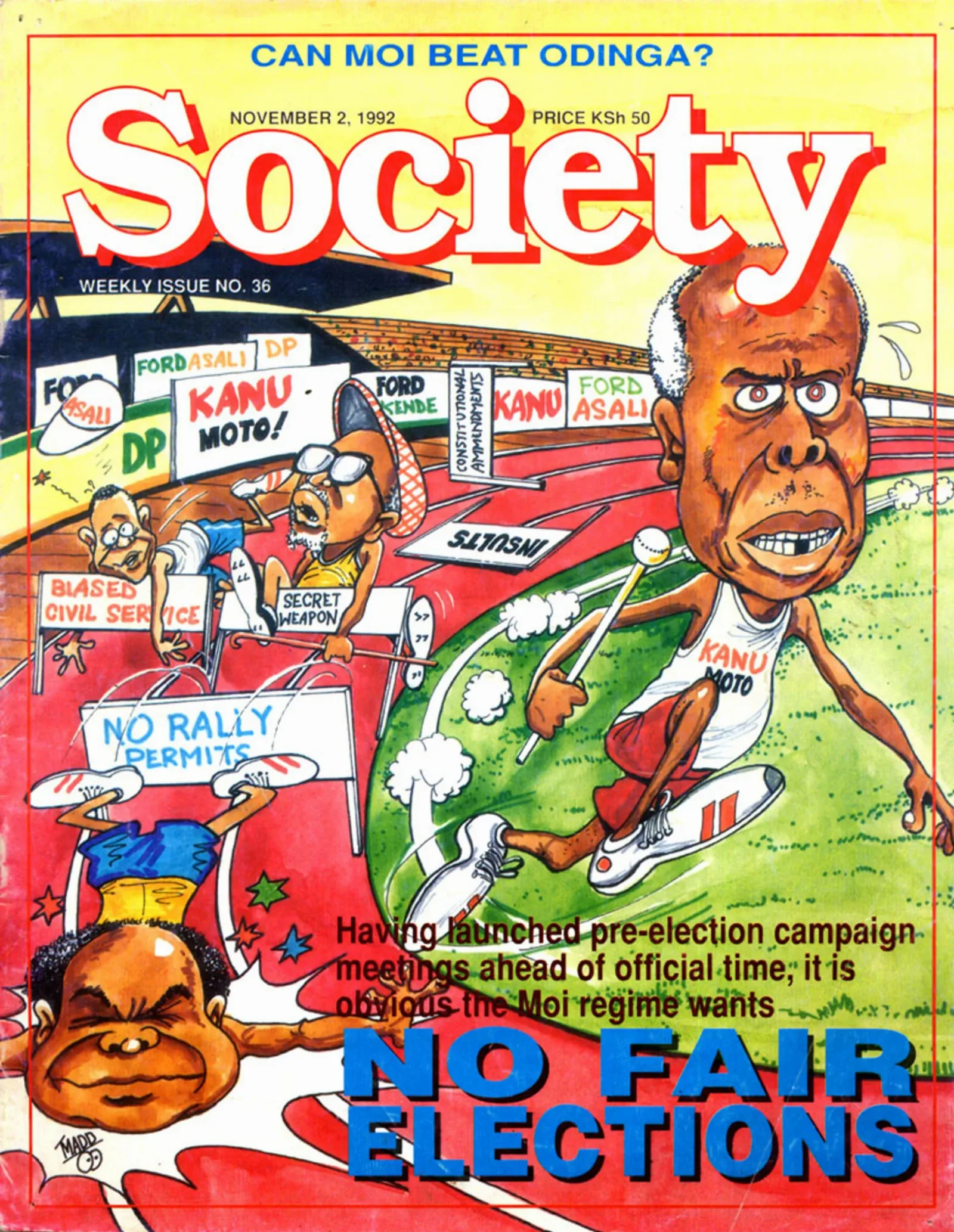
One of his most significant early milestones came in 1992, when he became the first cartoonist in Kenya to publish a caricature of President Daniel arap Moi.
The drawing appeared not in a newspaper but in Society Magazine, after editors Pius Nyamora and Mwenda Njoka encouraged him to take the risk.
It was no small matter. Nyamora’s offices had previously been petrol-bombed with Molotov cocktails.
Maddo recalled that the magazine appeared on a Monday, and nothing happened. Even the Special Branch, which often confiscated publications carrying sensitive material, did not collect the copies from the streets.
Years later, he discovered that Moi had actually enjoyed the cartoon.
“He had his humorous side and would enjoy a degree of humour,” Maddo said.
It was an early demonstration that even those who wield power can sometimes appreciate a well-aimed joke.
A page that travelled beyond Kenya
Maddo’s weekly cartoon page has evolved considerably over the years. It began as a 9cm strip spanning three tabloid columns, expanded to half a page in 1990 and became a full page in 1998. It has appeared in colour since 2001.
His working routine is equally disciplined. He takes notes throughout the week, makes rough sketches on Wednesdays, completes the drawings and inking on Thursdays, then scans and edits the work before sending it to the editor, often late at night.
The format also found admirers beyond Kenya. In a 2013 interview, Maddo noted that cartoonists in Tanzania, Uganda and Rwanda had adopted a similar composite-page approach.
His international connections extend beyond the region. In 2009, while undertaking a residency at the Rockefeller Foundation’s Bellagio Center in Italy, he compiled his It’s a Madd, Madd World features into three volumes. He has also held artistic residencies in Japan, Estonia and Germany.
In May 2022, Maddo and his colleague Godfrey Mwampembwa, popularly known as Gado, were jointly named Knights of the Order of Arts and Letters by France’s Ministry of Culture for their contribution to freedom of expression through cartooning.
Maddo is also an associate producer at Buni Media, the company behind The XYZ Show. While Gado founded and created the show, Maddo played an important behind-the-scenes role in its development and production.
Maddo also chairs Ketebul Music, reflecting interests that extend well beyond political cartoons.
The future of cartooning in a digital world
At the launch, Maddo acknowledged that technology, particularly artificial intelligence, presents both challenges and opportunities for cartoonists.
New digital platforms have become increasingly important as newspaper readership has declined and traditional media organisations have moved online.
“We welcome the challenge of online content, which has become useful even as newspaper readership has reduced tremendously, forcing us to go digital,” he said.
He is, however, concerned that excessive reliance on artificial intelligence could undermine creativity among cartoonists. Nevertheless, he remains optimistic about the future of the art.
His own career offers a compelling argument for its survival. A good political cartoon does something that a thousand words, a viral meme or a fleeting social media post may struggle to achieve: It distils a complicated political reality into one memorable image.
In 2015, Maddo became the first cartoonist to win an award at the CNN MultiChoice African Journalist Competition. He received the award in the GE Energy and Infrastructure category for Sorting out Nairobi Transport, a full-page graphic published in The Standard on Saturday. The judges noted that it was the first time the competition had recognised a piece of graphic journalism.
Other honours include the Media Council of Kenya’s Life Achievement Award and the Kenya at 50 Kenyatta University Heroes Award.
His work has also attracted direct praise from one of the holders of the country’s highest political office. Before becoming President, Mwai Kibaki observed that Maddo had an unusual ability to understand the true meaning of political and social situations and present them humorously, helping Kenyans understand themselves better.
Kibaki later offered him a more direct endorsement: “Wewe enda chora cartoon sawa sawa.”
The next Madd Madd World
Zahid Rajan, director of Zand Press, said the new anthology is available online through Zandpress.com and would be available from November 2 at Text Book Centre, Yaya Centre, and Nuria Bookshop. It retails at Sh3,000, while the first anthology, covering 2007 to 2011, sells for Sh2,500. Rajan said he hoped to complete two further anthologies covering 2017 to 2026 next year, preserving another decade of Maddo’s work.
For younger Kenyans, the importance of these collections goes beyond nostalgia or the preservation of newspaper cartoons. They offer an opportunity to revisit the country’s political history through the eyes of an artist who has consistently questioned authority, challenged hypocrisy and exposed the contradictions of public life.
At his drawing table, Maddo continues to work. The page is not finished. The world remains MADD.